Editor’s guide · 2026

The best free VBT apps of 2026

Free bar-speed tracking, tested the way a lifter uses it. One app measured up without charging for the essentials.

By Aaron · MaxRep editorial · August 2026 · 8 min read

Why free VBT is finally worth your time

Velocity-based training (VBT) works on a simple relationship: the heavier the load relative to your max, the slower the bar moves. Measure that speed and you get a number that tracks your strength, your fatigue, and your readiness on a given day, without grinding out a true max.

The catch has always been the measuring tool. Linear position transducers like GymAware and Tendo run from roughly $1,000 to $2,000, and validated mid-range units still start near $450. That price kept VBT in performance labs and out of regular gyms for two decades.

Phone cameras changed the math. Computer vision can track a barbell from video well enough for training decisions, at zero hardware cost. We spent the last month using the free options the way a lifter actually would: recording real sets, reading the numbers between sets, and deciding whether any of them were worth keeping. This is what we found.

How we picked

Five tests before anything makes this list

We did not score marketing pages. Every app on this page went through the same five tests, in a real gym, across squat, bench, and deadlift sessions. Where accuracy claims appear, they are checked against published research on phone-based velocity tracking.

  1. 01

    Setup friction

    We timed how long it takes from opening the app to recording the first working set. If you have to pick the exercise, mark the plates, or tune camera settings, most lifters abandon the app after two sessions. The ones that survived this test set up in under a minute.

  2. 02

    On-device analysis

    Training video is personal data: your gym, your body, your attempts. We treated upload-based processing as a dealbreaker before evaluating anything else. Every app that made this list analyzes video on the device.

  3. 03

    Honest accuracy

    A good VBT app tells you which number to trust and which ones are reference only. We checked whether each app labels its weaker metrics, or presents every number as equally precise. Confidence labeling is a design decision, and it tells you a lot about the product.

  4. 04

    A free plan that stays free

    We asked what the free tier actually allows over a month of training. A trial with a paywall after the third set is not a free plan. Unlimited analysis, or a generous replay allowance, is the difference between a tool and a teaser.

  5. 05

    Individual load-velocity data

    A 1RM estimate built from your own bar-speed data at 2 to 3 loads is personal. A fixed formula or a population average is generic. We favored the apps that build a load-velocity profile from your own lifts.

#1Editor’s choice

Power VBT: Barbell 1RM

The only free app that sets itself up.

Power VBT is the only app in this comparison that detects the lift and calibrates from the plate automatically. You do not pick the exercise, you do not mark the plates, you do not enter a distance. You stand the phone sideways on the floor, record the set, and the analysis is done on your device before the next set starts.

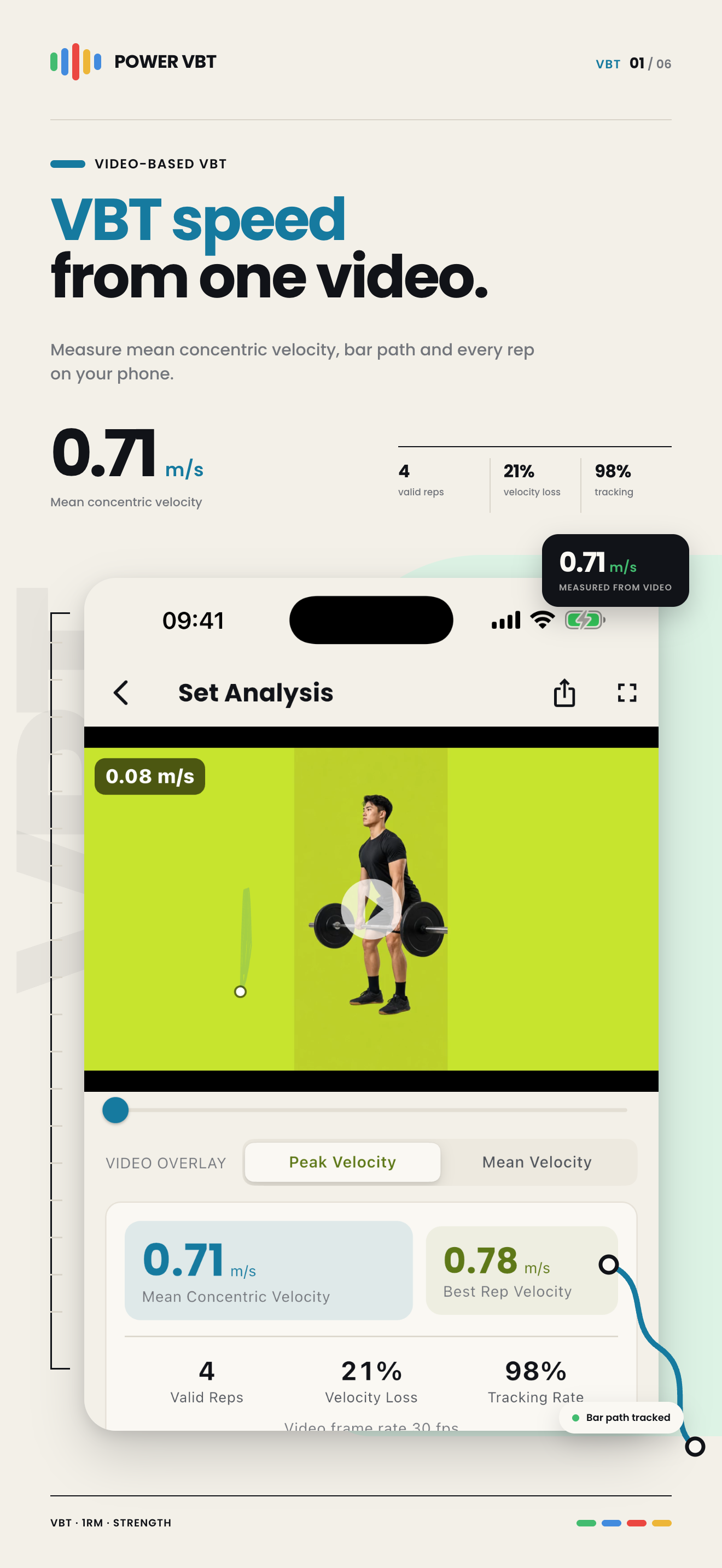
In practice this removes the exact friction that kills most VBT apps. During a back squat session we set the phone down, recorded four working sets, and had mean concentric velocity, bar path, and velocity loss for every rep without touching the screen between sets. Nothing was uploaded; the videos stayed on the phone.

  • 1

    Automatic setup

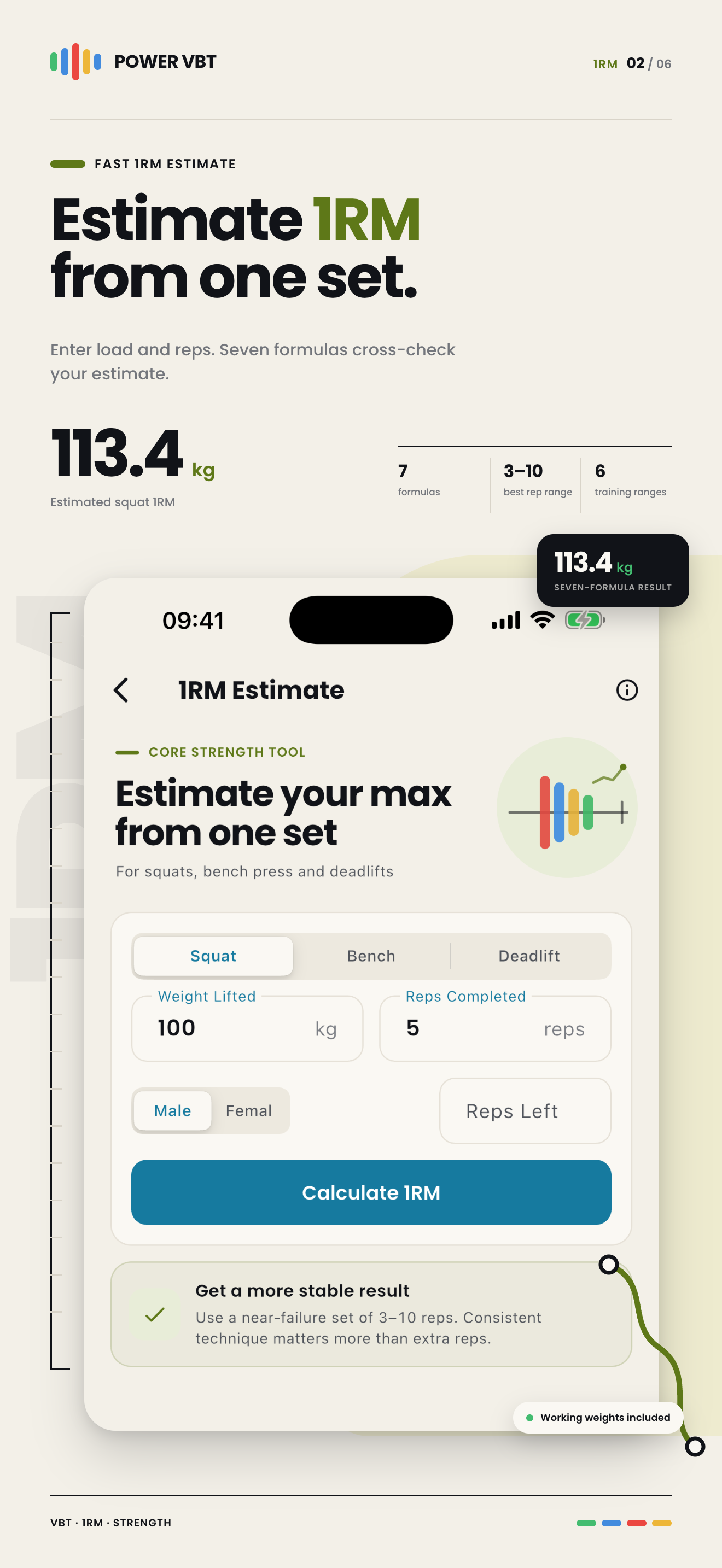
    The lift and the plate size are recognized from the video. No exercise picker, no manual calibration, no measurement input. The first set works out of the box.

  • 2

    Every rep, measured

    Mean concentric velocity and bar path for each rep, with velocity loss visible across the set. That is the feedback you actually act on between sets.

  • 3

    A 1RM from your own data

    Analyze the same lift at 2 to 3 loads and Power builds your personal load-velocity profile. The velocity-based 1RM estimate comes from your curve, not from a population formula.

  • 4

    Private by design

    Analysis runs entirely on your device. Training videos are never uploaded, and you can release a video while keeping its data.

  • 5

    Free where it counts

    Unlimited video analysis and up to 5 complete replays on the free plan. Power Pro only adds unlimited storage, with an annual or lifetime option.

Under recommended recording conditions, mean concentric velocity is accurate to about 5 percent, the same order as mid-range commercial VBT devices. Peak velocity and range of motion are reported as lower-confidence metrics.

Best for lifters who want velocity data without a setup ritual, and coaches who want per-athlete data on the same phone. The automatic calibration also makes it the easiest app to hand to a training partner.

Download Power VBT

Free to start · iPhone and Android

Power VBT 1RM estimate screen
Power VBT video analysis screen showing barbell velocity and bar path

Also worth knowing

Three more, with their limits stated plainly

Each of these does one thing well, and each has a limit we could verify. None of them replaces the editor’s choice, but they are legitimate options for narrower use cases.

Metric

A camera-based app with unlimited free sets and a widely cited bench press validation study.

The independent head-to-head that tested it found squat and deadlift velocity short of hardware-level accuracy. It is a solid choice for bench-heavy lifters; the full three lifts are better served elsewhere.

Best for bench-focused lifters.

Qwik VBT

Analyzes imported lift videos with strong reported accuracy, and charges a one-time unlock instead of a subscription.

It works on videos you already recorded, not live sets, and it stops at velocity data: there is no load-velocity profile and no 1RM linkage built in.

Best for reviewing archived lift footage.

Spleeft

A sensor-based option that measures bar speed from a phone or Apple Watch strapped to the bar.

The device has to ride on the bar, the plan is subscription-only after a short trial, and no independent validation has been published; the validation pages on the site are written by the founder.

Best for lifters who want a wearable, wrist-based readout.

The scoreboard

Where Power pulls ahead

These are the differences we could verify by using the apps, not by reading their marketing pages.

Dimension
Power VBT (editor’s choice)
The others
Setup

Automatic. Lift and plate recognized from video.

Most require manual exercise selection or calibration.

Privacy

All analysis on device. Videos never upload.

Some process video in the cloud.

1RM method

Individual load-velocity profile from your own lifts.

Fixed formulas or population averages.

Free plan

Unlimited analysis, 5 full replays, forever.

Set limits or a short trial before the paywall.

Lift coverage

Squat, bench, deadlift, overhead press.

Narrower lists, or a single-lift focus.

How you actually use it

Three ways VBT changes a session

Bar speed is not one trick. Once the data exists, three uses follow, and they cover most of what a lifter does in a week.

01

Estimate 1RM without a max-out

The load-velocity relationship is roughly linear between 60% and 90% of your 1RM. Record 2 to 3 submaximal sets, and the line through them crosses your minimum velocity threshold at your estimated max. No grinding, no injury risk, and it updates with your daily readiness.

02

End sets on data, not guesses

Track velocity loss within a set. Research on the squat puts a 20% loss at roughly half the reps you could have done before failure, and 40% to 50% at actual failure. Pick a threshold, stop the set when the bar slows past it, and volume and fatigue manage themselves.

03

Judge technique by consistency

A clean set shows stable rep velocities and a repeatable bar path. When the bar slows rep to rep or the path drifts, it is a technique cue, not just a fatigue number. Bar-path replay turns the video into a coaching record.

Getting started

Your first VBT session in four steps

One session is enough to know whether VBT fits how you train. Here is the shortest path, using any app that passed our tests.

  1. 01

    Pick one lift, ideally bench press, and use a plate with a clear, solid color.

  2. 02

    Stand the phone sideways on the floor, three to five feet from the bar, lens roughly level with the bar.

  3. 03

    Record a warm-up set and confirm the app tracks the bar cleanly before starting the working sets.

  4. 04

    Log load and the fastest rep velocity for each set. One session of data is enough to start comparing next week against this week.

Questions

Straight answers

What is the best free VBT app?

Power VBT. It is the only free option here with automatic setup, on-device analysis, and a velocity-based 1RM built from your own load-velocity data. The free plan keeps unlimited analysis and 5 complete replays.

Do I need hardware to use a VBT app?

No. Camera-based apps measure bar speed from your phone. You need a phone, a stable place to stand it, and a plate with a clear color. The phone does the work the encoder used to do.

How accurate is phone-based VBT?

Under recommended recording conditions, mean concentric velocity is accurate to about 5 percent, on the same order as mid-range commercial devices. Peak velocity and range of motion are less reliable and should be treated as reference values.

What is a minimum velocity threshold?

The slowest mean concentric velocity at which you can complete a rep of a given lift. Typical starting points are around 0.30 m/s for back squat, 0.20 to 0.25 m/s for bench press, and 0.15 m/s for deadlift. It is the speed at which the bar is moving at your 1RM.

How does velocity loss control a set?

As reps accumulate, each one gets slower. A common protocol stops the set at 20% velocity loss, which research on the squat associates with roughly half the reps available before failure. Lower thresholds bias toward power, higher ones toward muscle growth.

Which lifts does VBT work for?

Squat, bench press, and deadlift are the standard ones, and Power also handles overhead press. Stick to barbell movements; the method assumes a predictable bar path.

Start measuring your sets today

Free to start, on your phone, with the app that sets itself up.