
01
Compare formulas
See a reference range instead of relying on a single prediction.

Power VBT: Barbell 1RM
From estimate to measurement
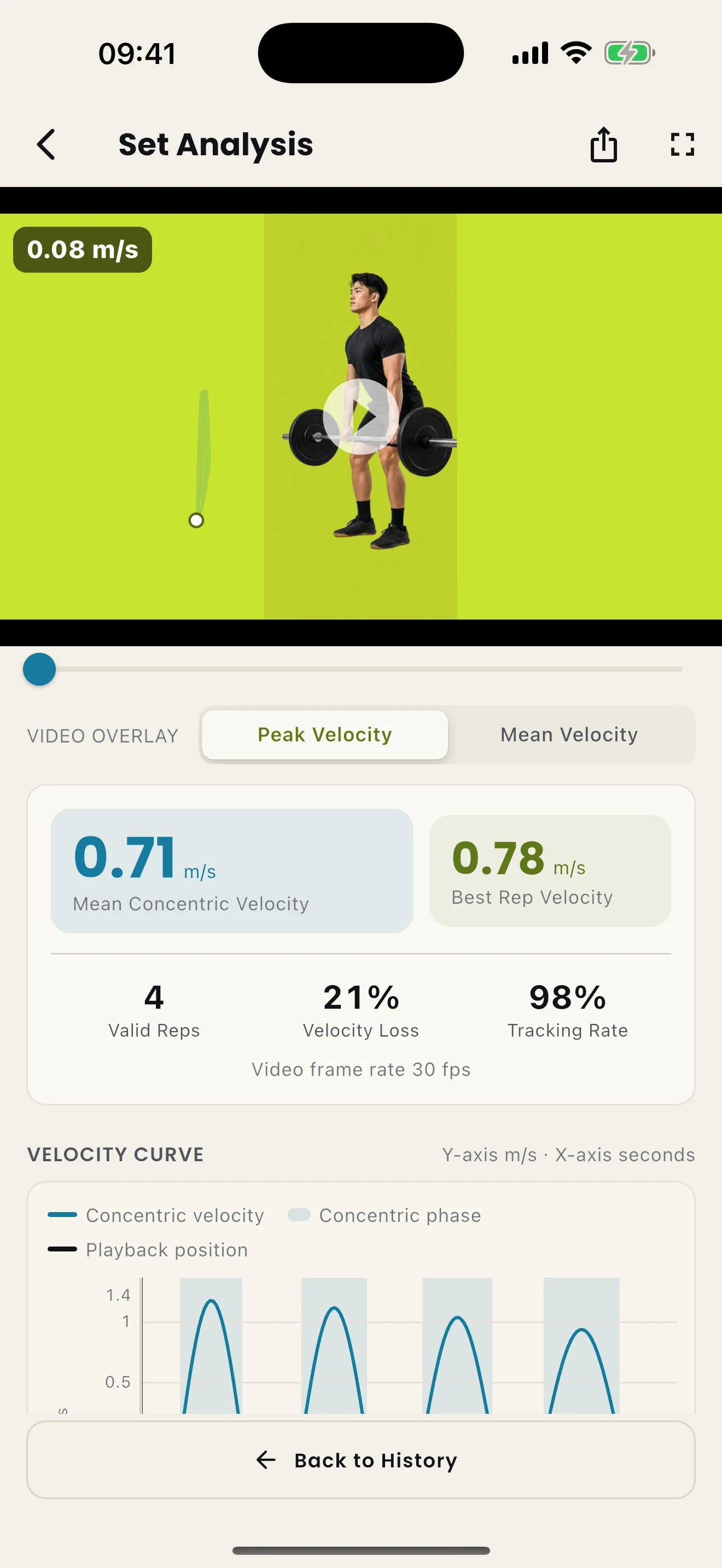
Import a set to measure rep-by-rep concentric velocity and bar path. Build a load–velocity profile for a more personal 1RM.
Start free · Video based · No extra sensor
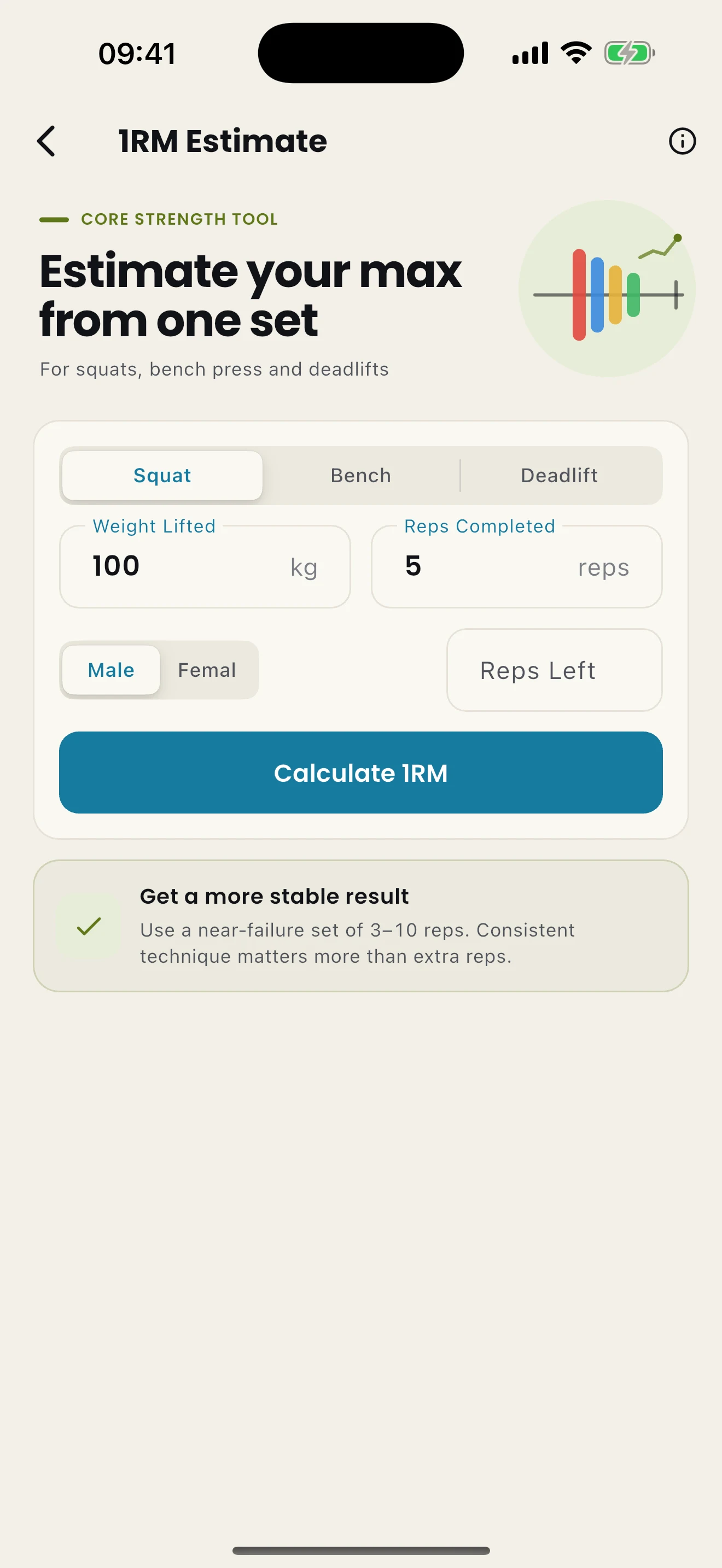
Estimate your one-rep maximum with proven formulas. Also calculate Rep Max and Percentages of 1RM.
Each formula below is shown with the same input: 100 kg lifted for 5 reps. The spread between formulas is the point.
| Formula | 100 kg × 5 reps |
|---|---|
| Linear fit | 113.9 kg |
| Brzycki | 112.5 kg |
| Epley | 116.7 kg |
| Lander | 113.7 kg |
Working weights derived from a 100 kg one-rep maximum. Treat them as starting points, not tested limits.
| Rep max | Working weight |
|---|---|
| 1RM | 114.2 kg |
| 3RM | 103.8 kg |
| 5RM | 97.9 kg |
| 8RM | 90.1 kg |
| 10RM | 85.6 kg |
| 12RM | 81.5 kg |
Four inputs, one clear result
Use a recent working set with consistent technique. The closer the set is to failure, the more useful the estimate usually becomes.
For a practical estimate, use a set of 3–10 reps performed with stable technique.
Power VBT
VBT · 1RM · Training log
From estimate to measurement
Import a set to measure rep-by-rep concentric velocity and bar path. Build a load–velocity profile for a more personal 1RM.
Start free · Video based · No extra sensor
Lift-specific tools
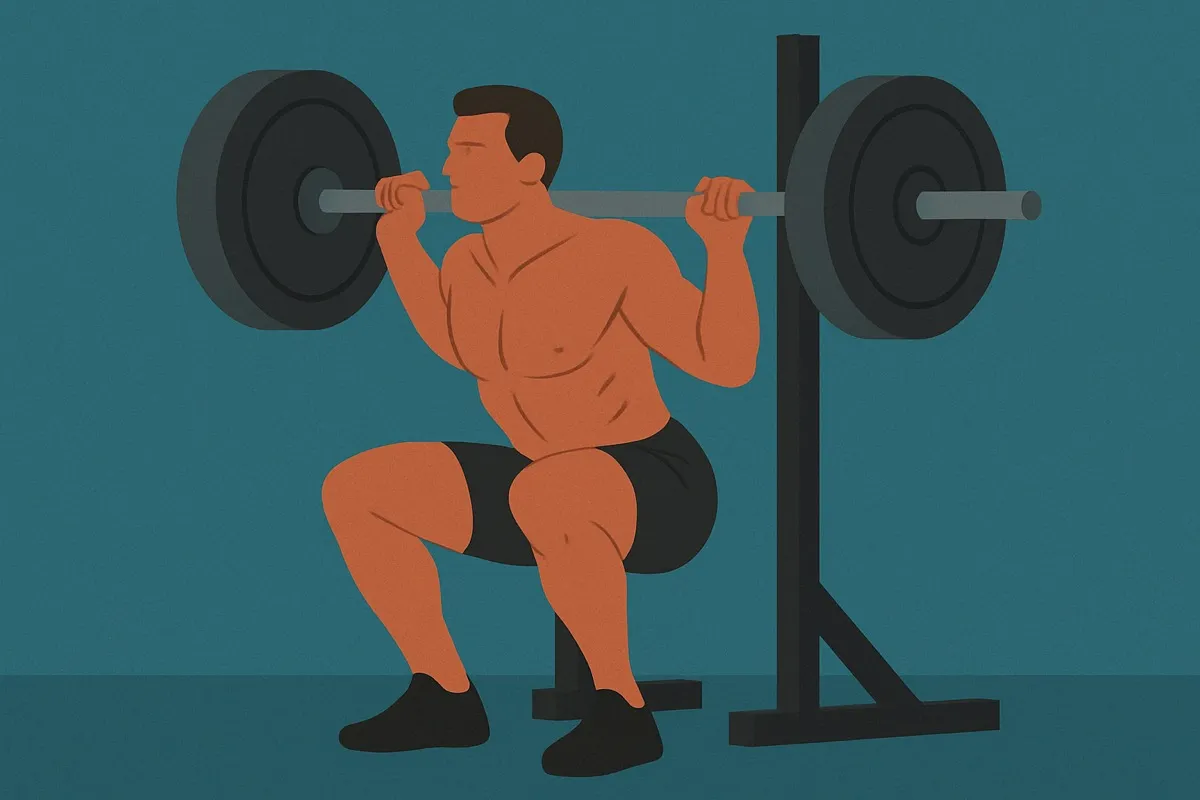
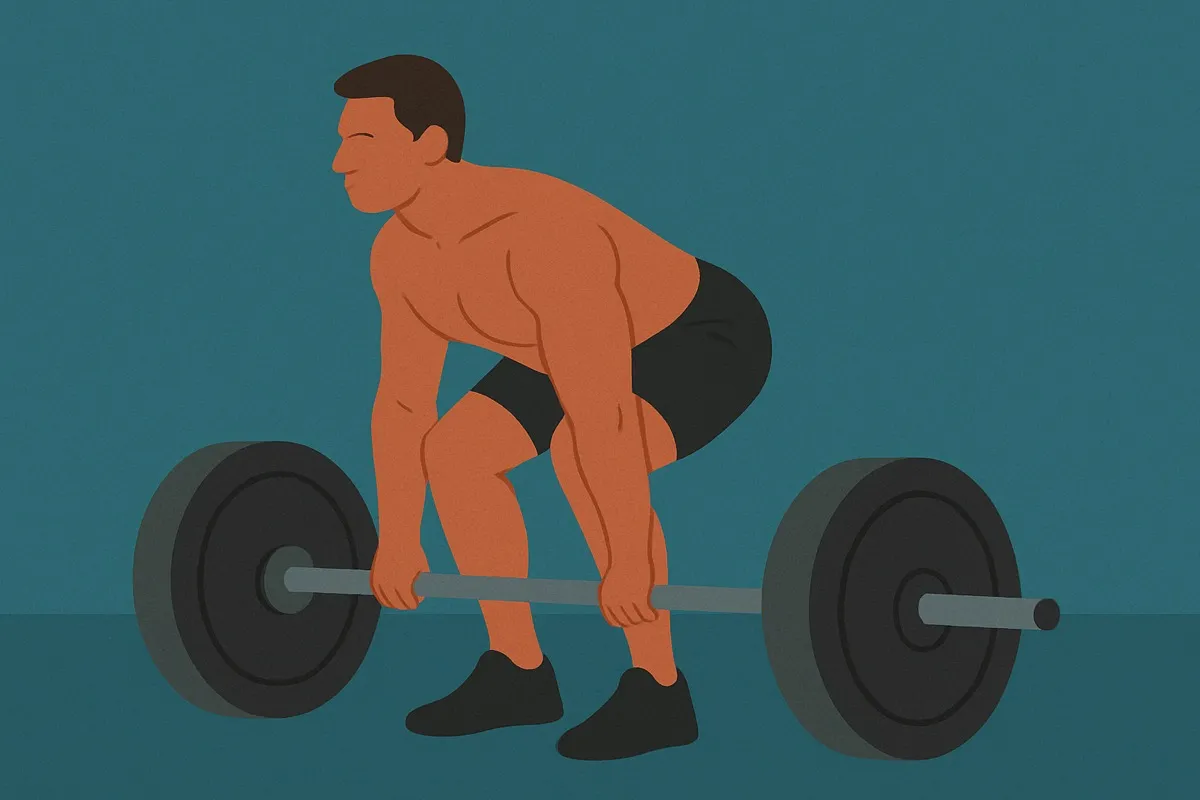
The same calculator logic, with guidance tailored to each powerlifting movement.
01
See a reference range instead of relying on a single prediction.
02
Convert the estimate into rep maxes and percentages for your next session.
03
Move from a population formula to your own video and load–velocity profile.
Your one-rep maximum is the heaviest load you can lift once with valid technique. It is commonly used to describe strength and set training intensity.
It is an estimate. Exercise, rep range, fatigue, and how close the set was to failure all affect the result, which is why this calculator shows several formulas.
No. A submaximal set is usually enough for programming. If you do test a true maximum, use appropriate experience, setup, and supervision.
A load–velocity profile uses how quickly you move several loads. It reflects your own lifting data instead of only a general rep formula.