How to Estimate 1RM from 5x5 Without Treating 5x5 as a 5RM
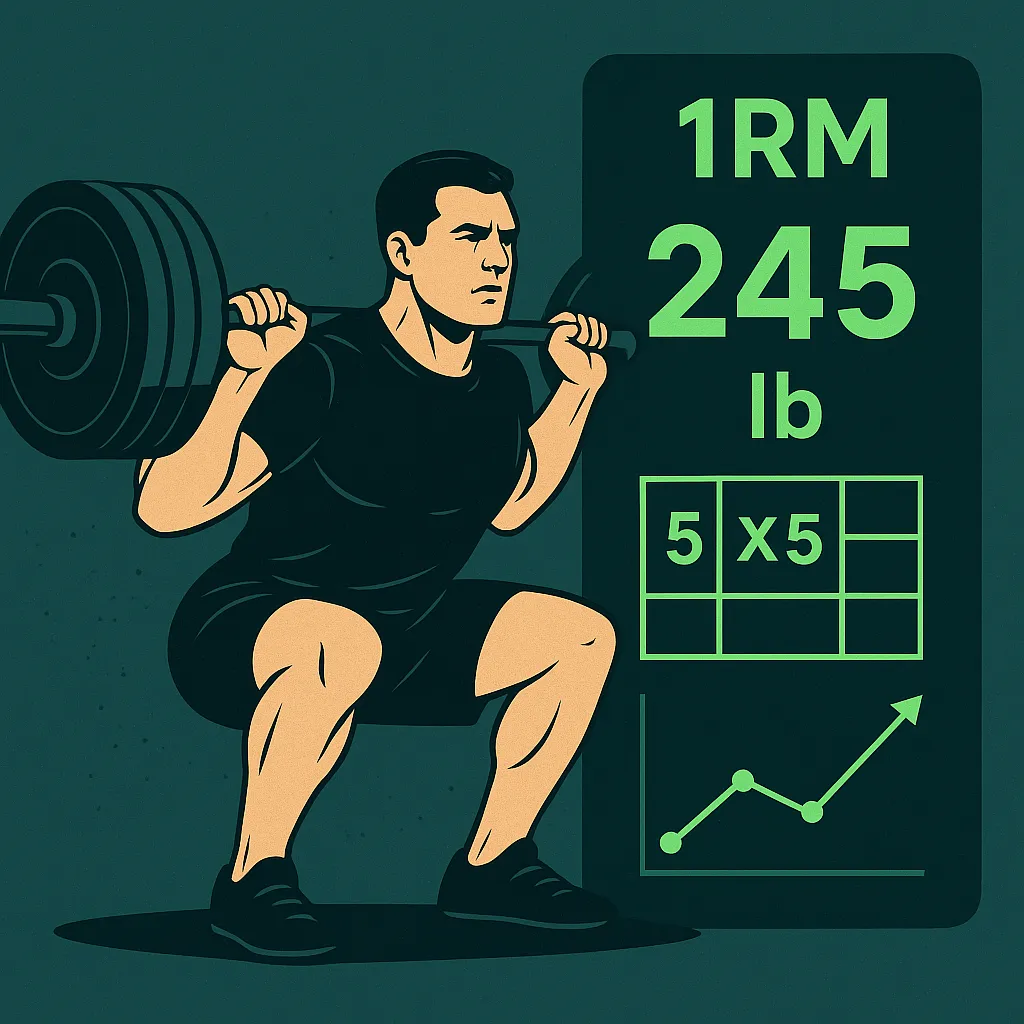
The weight you complete for five sets of five is usually lower than the heaviest weight you could lift for one set of five. That difference is why a plain “weight × 1.14” shortcut often underestimates a 1RM from 5x5 training.
Start with the last set, not the program name
Record the load, the final set’s RPE, and whether all five sets used the same movement standard. The final set carries useful information about accumulated fatigue.
For 100 kg across 5 × 5:
| Last-set result | Practical interpretation |
|---|---|
| RPE 10 | Final set was near a 5RM under fatigue |
| RPE 9 | About one rep remained |
| RPE 8 | About two reps remained |
| Technique changed | Do not rely on the rep count alone |
These RPE labels are estimates. Research on repetitions in reserve found that accuracy varies by proximity to failure and by individual, so record what you observed instead of treating the table as an exact conversion. See the RIR accuracy study.
Why calculators show a range
The MaxRep 5x5 1RM calculator compares several assumptions. Brzycki and Epley treat the working load as a five-rep maximum, while percentage-based methods assume the 5x5 load is a fraction of 1RM. Those models answer different questions, so a range is more useful than a false promise of exactness.
If the final set was RPE 8, the load clearly was not your 5RM that day. Use the RPE-adjusted result as the main reference and keep the other formulas visible as boundaries.
Use the estimate for the next block
Round the result to plates you can load. For a new training block, many lifters set a conservative training max below the estimated 1RM, then let completed sets determine progression. Recalculate from comparable work sets rather than changing the number after every easy or hard day.
The most useful trend has consistent exercise, depth or pause, equipment, rep range, and RPE. If any of those changes, label the record instead of comparing the numbers as though the test stayed identical.
Watch what happens across all 25 reps
Load and RPE summarize the workout, but they do not show where rep speed began to fall or whether bar path changed. Power VBT can analyze a video of the set, report mean concentric velocity for each rep, and save the trajectory. That makes 5x5 progress visible even before the estimated 1RM changes. Get Power VBT for iPhone or Android.